
Monday 10th May
We (my wife Beryl and I) were collected at 0430 by taxi in Sherborne and met the Leger (tour company) transport at Yeovil 0500, then onto Taunton. There we boarded a coach, which took us all the way to Folkestone, arriving around 1330 hours. The coach boarded the channel tunnel shuttle and by 1430 we were on our way to France. We finally arrived at the Falaise Ibis Hotel around 2100 where we had a quick meal, a hot bath and then into bed.
Tuesday 11th May
We left the hotel to travel first to Pegasus Bridge, which is a large bridge over the Caen Canal, which can be raised to allow ships to go through. There is another bridge over the River Orne, which runs parallel to the canal, called Horsa Bridge; Horsa being the name of the gliders involved in the attack and Pegasus being the symbol of the Airborne Division.
Both bridges were taken in the early hours of June 6th 1944, by gliders carrying paratroopers landing nearby, later to be reinforced by more paratroopers. Major John Howard who was in charge of the coup-de-main assault was awarded a DSO. The object of taking the bridges was to protect the beach head (Sword Beach) against tanks getting across the Orne from the East. The original Pegasus bridge had been moved to a nearby Museum and replaced by a wider replica.
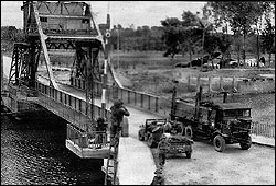
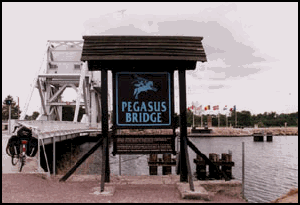
There is an excellent bust of Major John Howard just near to Pegasus Bridge marking the spot where the first glider landed carrying the paratroopers. We also visited the café Gondree just beyond Pegasus Bridge, the first French house to be liberated on D-Day and still run by the daughter of the 1944 owners. I bought some postcards and a small bottle of Calvados there (of which I drank quite a lot in 1944).
After that we went to Ranville cemetery, where many of the Paratroopers are buried. Then we travelled along the British and Canadian beaches; Sword to the East (British); Juno, the middle beach (Canadian/British) and Gold to the West (British). The length of this stretch of beaches is approximately 17 miles, stretching from Arromanches to Ouistreham, the ferry port of Caen (near to Pegasus Bridge).
We stopped for lunch in Arromanches and looked at the remains of the British built Mulberry Harbour, which is just off the shoreline. We also went into the Mulberry Museum and saw models of the Mulberry Harbour. We learned that the American Mulberry Harbour was destroyed by a storm shortly after D-Day.
After lunch we went to Bayeux where we broke away from the main tour and visited the Bayeux tapestry, which is extremely impressive. Heard the whole story leading up to the Norman invasion of 1066; how Harold was apparently a usurper of the throne, which had been promised to William by Edward, King of England. We also managed to take in a short, but adequate, visit to the Bayeux war museum, which was very interesting. I particularly noticed a display listing all the countries which had participated in the liberation, including believe it or not, Rhodesia, where I lived after the war.
We finished the first day with dinner back the hotel where we made two acquaintances (couples) so far; David and Laura Money from the Newcastle upon Tyne area; a young couple, very nice, very helpful to us oldies and intensely interested. They have supplied us with a copy of their photographs as I managed to mess up ours. The second couple is Les and Maureen Blackwell. Les is another veteran (D+2), an engineer; he was invalided back at Nijmegen.
Wednesday 12th May
We went first to the Merville Battery and museum. These guns, thought to be 150mm, were found in fact to be 100mm field guns. Lt Col Otway of the 9th parachute battalion put them out of action after a fierce battle in which he lost 70 of his 150 men. He should have had 700 but the drop went wrong and in fact many were drowned in the deliberately flooded Dives Valley, others were dropped too far away and were captured.
We then went to the US cemetery overlooking Omaha Beach and learned of the appalling casualties caused by the mortars, machine gun posts, beach obstacles and the lack of tank support as the amphibious DD tanks (Major General Hobarts “funnies”) has been offloaded too far out to sea and had subsequently sunk. The enormous and impressive cemetery contains 9386 graves.
After that we moved on to Pointe-du-hoc, where the American Rangers (the US equivalent of the British Commandos), had scaled the cliffs to attack the gun emplacements (150mm), which could have covered Omaha Beach. In fact there were no guns, they had not yet been mounted and were found and destroyed in a nearby orchard. US Casualties were 135 out of 225.
Finally, we went to St Mere Eglise which is inland from Utah Beach, which had been attacked by the US 82nd Airborne Division. It did not go too well. Some landed in an area flooded on Rommels orders; some landed on the square and were massacred by German troops. One trooper, Pte John Steele wound up on the church steeple and was captured. The rest of the regiment regrouped and liberated the town shortly afterwards.
Thursday 13th May
We first saw Jerusalem Cemetery where only 47 soldiers are buried, as the nearby village persuaded the Commonwealth War Graves Commission not to move them. We then went via Tilly-Sur-Seulles to Villers Bocage and heard of the German tank ace Michael Wittman knocking out 7th Armoured Division tanks in the village, below Hill 112, going down the street and back again to be knocked out on his return by two tanks who had concealed themselves.
We did also go up Hill 112 and saw how it commanded Normandy and how we only really drove through after we took it, at the end of many fierce battles. To finish off our tour in a fitting fashion, we went to St Lambert and Falaise to finish at Coudehard, where the Polish memorial is and the battle of Normandy ended.
Friday 14th May
Beryl and I broke away from the tour and came home from Caen to Portsmouth by Fast Ferry and then by train, reaching home at 6.15pm.